Of all the gear on a Connecticut boat, the one piece that has actually saved lives is the life jacket — and the state has specific rules about who has to wear one, what type counts, and how it has to fit. Whether you're driving your own pontoon on Candlewood Lake, skiing on Lake Lillinonah, or just tubing with the kids for an afternoon, here's the plain-English version of Connecticut's PFD laws from the crew that's on the water every day.
In Connecticut, children under 13 must wear a USCG-approved life jacket while underway on any recreational vessel (with a few exceptions), and everyone must wear one on a PWC or while being towed behind a boat. Every person on board also needs a wearable PFD that's accessible, serviceable, and the right size. On our charters, all of that is provided and correctly sized for every guest — kids included.
Who has to WEAR a life jacket in Connecticut
Connecticut draws a clear line between carrying a life jacket and wearing one. Most adults on a boat are only required to have one accessible. But three groups must actually have it on and buckled whenever the boat is underway:
- Children under 13. Any child under 13 must wear a USCG-approved PFD while underway on a recreational vessel that is not anchored, moored, or docked. The rule applies on open water and on boats of every length — from a 12-foot john boat to a 24-foot pontoon. (Confirm the current age threshold and any exceptions with CT DEEP before you head out, because the details around age cut-offs and vessel type can shift.)
- Anyone on a personal watercraft (PWC). Jet Skis, Sea-Doos, WaveRunners — everyone on board, operator and passenger alike, must wear an approved PFD. Inflatable PFDs do not qualify on a PWC.
- Anyone being towed. Water skiing, wakeboarding, wakesurfing, tubing — if you're behind the rope, you must wear an approved, inherently buoyant PFD. Inflatables are not allowed for towing.
For everyone else on a conventional boat, the rule is "readily accessible" — you must have a wearable PFD that fits you within arm's reach, but you're not required to wear it. That said, on our charters we hand them out and encourage wearing them, especially for weaker swimmers and kids.

Kids under 13 must wear a USCG-approved PFD while underway — no exceptions on open water.
The five USCG life jacket types, explained
The Coast Guard sorts PFDs into five types. Connecticut's wear requirements all reference these, so it's worth knowing what each one is:
- Type I — Offshore Life Jacket. The most buoyant; will turn an unconscious wearer face-up in rough, open water. Bulky. Rarely seen on inland lakes but the right call offshore.
- Type II — Near-Shore Buoyant Vest. Good for calm inland water where rescue is close. Will turn most unconscious wearers face-up, but not as reliably as a Type I.
- Type III — Flotation Aid. The most common PFD on Connecticut lakes — comfortable, designed for activities like skiing and tubing, and worn in calm water where a quick rescue is likely. This is the type most of our charter guests wear. It will not turn an unconscious person face-up.
- Type IV — Throwable Device. A cushion or ring meant to be thrown to someone in the water, not worn. Required on boats 16 feet and longer (see below).
- Type V — Special-Use. Includes deck suits, windsurfing vests, and hybrid inflatables. Only counts when used exactly as the label specifies.
For Connecticut's under-13 wear rule, the PFD must be a wearable Type I, II, III, or a Type V that's approved and worn per its label. A Type IV throwable does not satisfy the wear requirement for a child.
The throwable rule: boats 16 feet and longer
In addition to a wearable PFD for every person on board, any vessel 16 feet or longer (except PWCs and canoes/kayaks) must carry at least one Type IV throwable — a ring or cushion — that's immediately available for quick deployment. On a typical 22-foot pontoon, that means four or six wearable PFDs plus a throwable cushion, all in serviceable condition.
Keep the throwable where you can grab it in one motion — not buried under towels or coolers. If someone goes over the side, you do not have time to dig.
Fit and sizing: why a loose PFD is dangerous
A life jacket that doesn't fit is barely a life jacket. If it's too big, the jacket rides up over the wearer's face when they hit the water; too small and it won't float enough to hold them up. For kids especially, sizing is by weight, not by age or chest size — check the label for the weight range.
A quick field test we use with the kids on our kids watersports clinics is the chin test: put the jacket on, buckle it snug, then lift the child by the shoulder straps. If the jacket lifts past their chin or ears, it's too big. Tighten the straps or move down a size. The PFD should hug the torso and not pull above the ears.
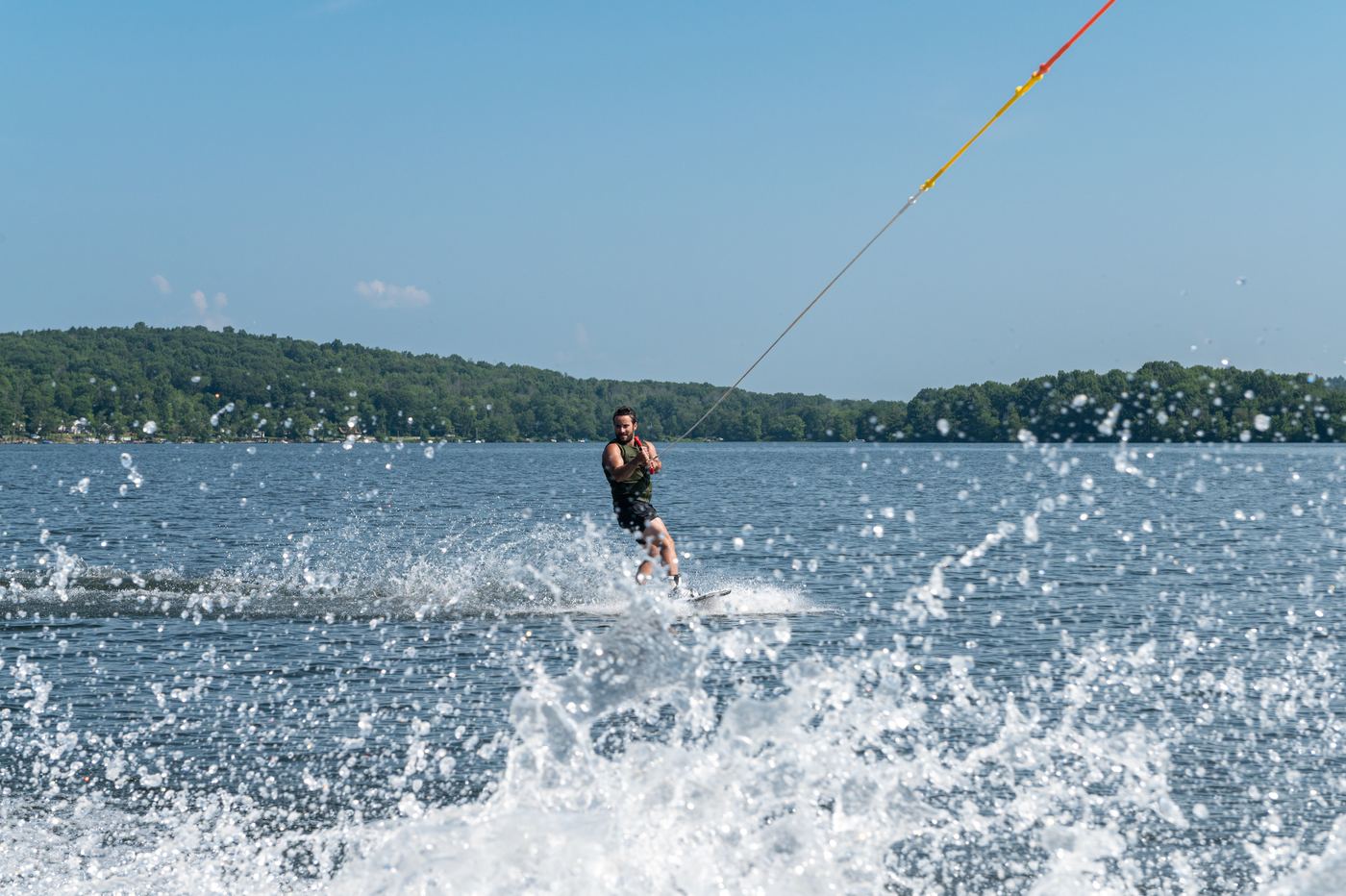
A properly fitted Type III PFD on a skier — snug, buckled, and ready for the rope.
Connecticut-specific notes: accessible, serviceable, and the inflatable catch
CT law doesn't just want you to own a PFD — it wants it usable. Three things officers look for:
- Readily accessible. PFDs can't be locked in a compartment, bagged up, or buried under gear. They need to be within reach of the person who'll wear them.
- Serviceable. No rips, broken buckles, waterlogged foam, or faded/stained fabric. If it's falling apart, it doesn't count.
- Correctly sized. A child wearing an adult PFD doesn't satisfy the under-13 wear rule — it has to actually fit.
Inflatable PFDs (the belt-pack or suspender styles) are popular with adults, but they come with strict limits. They're only approved for wearers 16 and older, they don't count for anyone being towed or on a PWC, and they must be worn (not just carried) to count toward the carriage requirement. Many also require being armed with a CO2 cartridge and re-armed after each deployment — check the indicator window before you leave the dock.
Penalties and how enforcement works
Connecticut's Environmental Conservation (EnCon) Police and local marine patrols actively check PFD compliance on lakes like Candlewood, Lillinonah, and Highland, especially on summer weekends. A missing, ill-fitting, or unserviceable PFD can result in a citation, and if a child under 13 isn't wearing one while underway, that's a separate violation. Exact fine amounts change over time, so confirm current penalties with CT DEEP rather than relying on a number you read online.
In practice, officers tend to do a quick "PFD count" when they pull alongside: wearable for every person, throwable on boats 16+ feet, kids under 13 wearing theirs, and anyone on a PWC or behind the rope wearing one too. If all that checks out, you're usually fine.
Who / when / what's required
| Person | When | What's required |
|---|---|---|
| Child under 13 | Underway on any recreational vessel (not anchored/moored/docked) | Wearable Type I, II, III, or approved Type V, worn |
| Anyone on a PWC | Always, while underway | Inherently buoyant wearable PFD, worn (no inflatables) |
| Anyone being towed | Skiing, wakeboarding, wakesurfing, tubing | Inherently buoyant wearable PFD, worn (no inflatables) |
| Everyone else on board | Always | Wearable PFD, readily accessible and correctly sized |
| Boats 16 ft and longer | Always (except PWCs and canoes/kayaks) | One Type IV throwable, immediately available |
Quick FAQ
All the right gear, already on board
On our charters all required life jackets are provided and correctly sized for every guest — kids included — so you don't have to bring a thing. Our captain handles the safety check, the fit, and the throwable, so all your group has to do is show up and enjoy the lake.
Book a Charter Explore Watersports